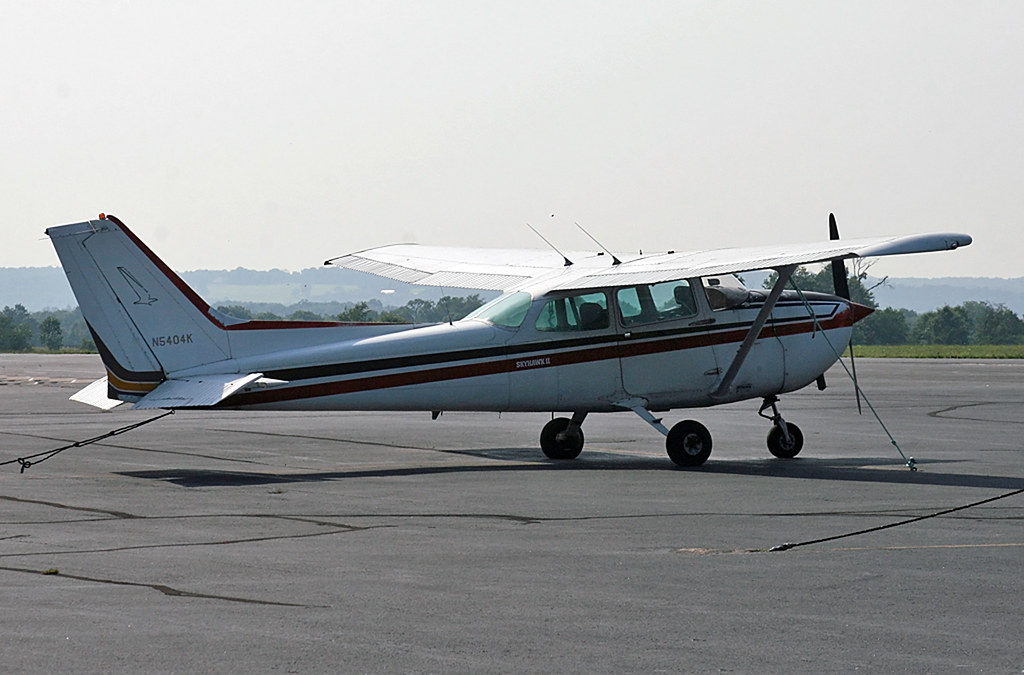
The hangar at the Kent State University Airport is part of the facility that has been without a master plan for several years so a new plan is being developed for the facility in Stow.
(Paul Tople/Akron Beacon Journal)
KENT: Eight years ago, Kent State wanted to decommission its airport and move elsewhere. But the Federal Aviation Administration, which has final say about the property, said the airport was too important to move and that it didn’t want to waste the $3.9 million it had given KSU for improvements there.
Now, university officials are taking a fresh look at the 287-acre airport between state Route 59 and River Road in Stow in Summit County.
“We were stuck with a plan that we couldn’t act on,” airport operations coordinator Dave Paluga said. “Since the last plan, there has been a lot of economic changes. We’ve been stuck in a status quo.”
The university has hired consultant C & S Cos., headquartered in Syracuse, N.Y., to conduct public meetings and develop a proposal for the KSU trustees and the FAA. Funding comes from a $600,000 FAA grant.
The main goal of the master plan will be to “determine what is needed to meet the current and future needs of the airport,” according to the university.
The master plan will include an airport layout plan, a schedule of priorities and funding sources for proposed improvements, KSU said.
The airport is both a training ground for KSU flight students and a Stow community resource — plus sometimes a bone of contention for nearby residents who believe the aircraft are too noisy or fly too low.
Complaints reached a crescendo about eight years ago when KSU considered expanding or moving the airport. But Stow city officials, then as now, want the airport to stay right where it is.
“If there are ongoing concerns, I want the city to be a part of developing any changes,” Stow Mayor Sarah Drew said this week. “The airport is an asset to Stow.”
The airport, formally called the Andrew W. Paton Field after KSU’s first flight instructor, was used as a landing field in World War I. KSU bought it in 1947.
One of 29 general service airports statewide, the facility serves twin- and single engine aircraft used for business, pleasure and training. A for-profit company, Commercial Aviation Corp., leases multiple hangars for aerial photography, flight training, charter flights and more.
Mostly, though, the airport is used by about 200 KSU students studying in what is the largest flight-training program in Ohio. The university has about 24 planes.
Expansion probably isn’t in the offing, airport operations coordinator Thomas Friend said.
“We may get a few more aircraft and get rid of a few, but we don’t have the facilities to expand,” he said.
John Trew, president of the Portage County Regional Airport, said he would welcome the relocation of the KSU airport to his Ravenna facility, one of the options discussed in the last master plan. But that isn’t to be, he said.
KSU officials “told us in the last two years that they’re going to do whatever they have to do at their own field,” he said.
What that will be isn’t clear now.
Gregg Floyd, senior vice president for finance and administration at KSU, said in a media release that the university is deferring any reinvestments at the airport until the master plan is completed in 18 months, but that some improvements are needed.
“The needs are becoming urgent,” he said. Comments about the future of the airport should be directed to Aileen Maguire Meyer of C & S at 216-619-5449, 877-277-6583 or amaguire@cscos.com.
The sixth edition of the popular event promises a chance for the daring to experience microlight flight and much more.
This year’s Fly-In to be ‘bigger & better’
By Raynald C Rivera
Fancy something intrepid this coming year? The sixth edition of Al Khor Fly-In promises a chance for the daring to experience microlight flight -- the highlight of the two-day event which aviation enthusiasts in Qatar have been looking forward to.
“We witnessed long queues during the last edition of the show with many still wishing to try the air tours, but we could not accommodate everyone, so we are finding ways to make sure more aviation enthusiasts would be given the opportunity to try out the tours,” Abdullah Al Hajj, Organizing Manager of Al Khor Fly-In, told The Peninsula.
The success of the previous edition was no surprise as flying enthusiasts were treated to a thrilling ten-minute ride on a private plane for a minimal fee. Unlike in large aircraft, flying in small planes provides an exciting experience to passengers, who can get a bird’s-eye view of the landscape below.
“Flying in a microlight provides a different feeling compared to riding a normal plane. You can feel the wind on your face and you can see clearly the beautiful scenery below,” said Al Hajj.
To accommodate more people, Al Hajj said they were expecting five to nine planes for the tours, including German-made autogiros, French-made microlight aircraft, a fixed-wing aeroplane from Italy and an American-made Cessna.
“All the planes that would be utilised for the tours are based in Qatar,” he said.
Forty planes from various countries are coming for the two-day event.
“We expect more people and aeroplanes participating this year. Around 40 planes from Saudi Arabia, the United Arab Emirates and Kuwait have already confirmed participation for the event,” Al Hajj said.
Last year, more than 30 small and light aircraft participated in the event, which attracted around 7,000 visitors during its two-day run.
The participating planes will be arriving on January 17 for the show, which will take place on January 18 and 19 at the Al Khor Airfield.
“Other than the 40 aeroplanes, there would also be radio-controlled model aeroplanes which would participate,” said Al Hajj, adding they were expecting new planes to take part in the event.
Lunched in 2008, the Al Khor Fly-In is a show organized by owners of light aircraft in Qatar to introduce aviation as a sport and hobby to the youth and the general public. It also serves as a get-together for pilots in Qatar and the other GCC countries.
Apart from providing thrill and entertainment, the event is quite educational, as the visitors get a close look at a diverse range of aircraft, from jets and propeller-driven aircraft to microcopters and autogiros.
The visitors will also get to speak to professional pilots who would be available to answer queries about their planes.
Being held under the patronage of Qatar Civil Aviation Authority, the event will see participation by the Ministry of Interior, the Internal Security Force (Lekhwiya), Qatar Aeronautical College and local flying teams.
The event’s gold sponsors include Qatar Airways, Qafco, RasGas, The Seashore Group, Barwa, and Al Misnad Transport, while the silver sponsors are Al Jaber Trading and Contracting and Venture Gulf Rent-a-Car.
In view of the success the event enjoyed last year, the organisers said they expected more visitors this time.
“Last year was a big success. Based on the feedback we received, all visitors enjoyed the event, especially the trips, which had a high demand, so we really expect more people would be coming,” said Al Hajj.
The sixth Al Khor Fly-In would be open to the public from 9am to 4.30pm on January 18 and 19 at the Al Khor Airfield, which is located 31km north of Doha to the east of the Al Khor coastal road. The Peninsula http://alkhorflyin.net
(Trinidadian Guardian)
A Caribbean Airlines pilot would never have shouted at passengers. This
was the response to a passenger in a letter to the editor of T&T
Guardian published on Thursday, who claimed that the pilot of Flight
BW501 to T&T from New York on December 20 had yelled at them. After
passengers complained about delays, the pilot asked how they would like
it if he took the plane up, then got tired and “crashed into the
Atlantic.” The flight had been
scheduled to leave the previous day, December 19. In her letter,
Laura-Mae Britton said passengers were asked to disembark and board the
flight twice after promises that the problem would be fixed. She said
the second time passengers boarded, they were told they were waiting
because some passengers were missing. It was only after the pilot
announced that the plane would not be able to fly that night, Britton
said, that passengers had become irate. “In response the pilot
again came on the speakers, yelled at us and basically said that we were
being petty and irate,” wrote Britton. She said he then went on a
“miniature tirade” about being awake at 5 am and leaving his wife and
children at home. But CAL communications manager Clint Williams said you
would never have heard such a thing from a CAL pilot. In a telephone
interview yesterday, Williams said the pilot of that flight was not a
CAL employee. “It was a pilot operating
a flight from a lease company,” Williams said. He said CAL normally
leased flights from the company, OMNI Air International, during busy
periods, and they had a longstanding relationship. Williams said CAL had
requested an in-depth report from OMNI Air International and would
evaluate what it said. Until then, he said: “It would be improper to
comment further.” He said the airline was
aware of the situation and had been alerted to the comment via social
media. Williams said the airline knew the aircraft had a mechanical
problem and an indicator meant the aircraft could not fly without being
checked. “It turned into a creeping delay, where the crew expected that
the problem would be fixed in a certain amount of time and it wasn’t.
That resulted in the crew running out of flying hours.” Williams said all aircrew
flew under strict rules on how long they could man an aircraft. “There
are mandatory rest periods and the crew’s hours would have run out.” He
said the further delay in the flight was caused when the company tried
to arrange an alternative aircraft and crew. “They eventually got three
other aircraft and we got the passengers here.”
A United Airlines flight prepares to touch down at Sloulin Field International Airport. With the addition of United and Delta flying into and out of the airport, travelers have seen improvements.
With two new airlines flying into Sloulin Field International Airport, travelers have seen improvements in airline service flying in and out of Williston.
According to Airport management, overall delay times have gone down with United Airlines and Delta Airlines providing service to Sloulin Field.
Steven Kjergaard, airport manager at Sloulin Field, said that the airport has not seen any delays over an hour since the new airlines started flight, which he said is an improvement over when Great Lakes was the only provider to the area.
But the arrival of United and Delta hasn’t been all positive for Sloulin Field.
As reported in a previous Williston Herald story, the number of passengers that pass through Sloulin Field has greatly increased, causing strains.
These increases have led to the airport terminal being crowded and the parking lot being well above capacity.
With airline traffic being about as he expected during the holiday season, Kjergaard said that vehicles were parked along 35th Street and Airport Road.
Kjergaard said almost every street around the airport had some cars parked on them.
In the previous Herald article, Kjergaard recommended that travelers carpool or get a friend to drive them to the airport.
“They didn’t heed my warning,” Kjergaard said.
Relief to Sloulin Field’s parking problems is right around the corner. The Williston City Commission approved a plan to contract with engineering firm Kadramas, Lee and Jackson, with the hopes of building more parking in the spring.
The pilot of a twin-engine plane with four people on board was forced to perform an emergency landing Saturday at Phoenix-Mesa Gateway Airport because of problems with the landing gear, officials said.
The pilot of the King Air first circled the airport to burn off fuel before the landing, officials said.
“The plane landed with the nose gear down but not locked,” FAA spokesman Ian Gregor said.. “It collapsed after the plane landed.”
The damage to the plane was unknown and the FAA will investigate why the nose gear didn’t go down, Gregor said. He did not know where the plane left from.
The plane was diverted from Scottsdale Airport to Gateway because of its longer runway after the pilot was unable to lower the plane’s nose gear, Gregor said.
Mesa Fire spokesman Ken Hall said four fire trucks and ambulances were stationed at Gateway “in case something happens.”
Hall said the pilot was in constant contact with the airport’s tower, which was relaying information to fire personnel.
http://www.azcentral.com MESA, Ariz. -
An airplane had a rough landing at Mesa Gateway Airport after its nose gear wouldn't fully open on Saturday night.
The plane was preparing to land at Scottsdale airport when it started having difficulty lowering its nose gear.
The pilot used several methods to try to lower the gear and burn off excess fuel. Eventually the pilot rerouted to Mesa Gateway Airport because it has longer runways, in case of an emergency belly landing.
There were four people on board the plane, including the pilot.
The plane landed in Mesa, but the nose gear did collapse upon landing.
One person complained about shoulder pain that was from an injury prior to the plane landing. That person wasn't taken to a hospital.
PROVO, Utah (ABC 4 News) - A firefighter from Provo was in the right place at the right time—30,000 feet above ground.
On Dec. 1, firefighter and paramedic Joel Burrows put his skills to use on a late night flight to Atlanta.
“A flight attendant got over the radio was asking for a doctor or nurse,” he told ABC 4.
Burrows was escorted to first class where he found a man very pale and sweaty and having a cardiac crisis.
“I
laid him down, raised his feet, took some vitals,” said Burrow. “I
started an IV, gave him some oxygen, hooked him up to a cardiac
monitor.”
Burrows was surprised by how well-equipped the airlines are when it comes to medical devices.
“The airlines actually have a lot of medical equipment on board, they were ready to go,” he said.
The
plane diverted to Memphis where paramedics on the ground took over. “I
don't think he would have made it to Atlanta,” Burrows said about the
man. “His pressure was 60 over 40 unknown if it was going to continue to
drop or not.”
A nurse from Utah Valley Hospital was also on the plane and helped.
It may be six months before it will be known if any charges will be filed against the company and crop duster pilot responsible for spraying farmworkers with agriculture chemicals the night of Dec. 21.
According to state law, the Arizona Department of Agriculture (AZDA) has six months to investigate the incident, which resulted in 10 farmworkers being transported to the hospital after a crop duster sprayed them with agchemicals while they were working in a field west of Avenue G and County 12th Street.
If the investigation reveals any violation of the law, “appropriate regulatory actions will be taken according to our statute and rule penalty authorities,” said Jack Peterson, AZDA associate director of the environmental services division.
Peterson declined to identify the pilot of the crop duster involved, or to release the name of the company employing the pilot.
“This is an ongoing investigation, and we do not release information until the investigation is complete,” he said.
AZDA is in the process of identifying all crop duster pilots who were applying aerial pesticide applications in the area at the time, as well as any ground-based applications which may have been made.
“We must look into all applications to determine if any of them could be involved, so this would include both aerial and ground applications,” Peterson said. “This could include applications that occurred prior to the work crew entering the field.”
Investigators are also working to identify the pesticide the farmworkers were sprayed with.
“Once we are confident in what pesticide was sprayed, we will carefully review this to ensure the application was made according to the requirements specified on the label,” Peterson said. “Everyone is cooperating fully as everyone wants to avoid things like this ever occurring. They want to know if anything was done incorrectly to ensure it doesn't happen again.”
Emergency personnel with Rural/Metro responded to the scene of the incident at about 7:30 p.m. Dec. 21. They found the crop duster had passed over two field worker buses, spraying about 40 farmworkers with agchemicals.
Many of the farmworkers were complaining of irritation to the eyes, nose, throat and skin after being exposed to the agchemicals. Because of the large number of patients involved, Rural/Metro was assisted by the Yuma Fire Department and the Somerton/Cocopah Fire Department.
Emergency personnel with Rural/Metro and YFD set up a portable decontamination zone at the site while Yuma County Sheriff's deputies cordoned off the area.
The process of decontaminating each farmworker involved stripping them down and then rinsing them off with a fire hose. The situation was made even more unpleasant because the temperature was in the mid-50s.
After initial decontamination, at least 10 farmworkers were sent to Yuma Regional Medical Center for additional treatment. Nine of the workers were released later that night after further decontamination and evaluation in the Emergency Department. One person was admitted overnight and released the next morning. None of the injuries were critical.
NTSB Identification: CEN13LA119 Nonscheduled 14 CFR Part 135: Air Taxi & Commuter Accident occurred Saturday, December 29, 2012 in Big Lake, TX Aircraft: BELL 407, registration: N534MT Injuries: 4 Uninjured.
This is preliminary information, subject to change, and may contain errors. Any errors in this report will be corrected when the final report has been completed. NTSB investigators may not have traveled in support of this investigation and used data provided by various sources to prepare this aircraft accident report.
On December 29, 2012, about 1148 central standard time, a Bell 407 helicopter, N534MT, lost engine power and crashed while diverting to Reagan Municipal Airport (E41), Big Lake, Texas. The three crewmembers and one passenger received no injuries. The aircraft received substantial damage. The aircraft was registered to and operated by Med-Trans Corporation under the provisions of 14 Code of Federal Regulations Part 135 as an on-demand Emergency Medical Services operator. Visual meteorological conditions prevailed for the flight, which operated on a company visual flight rules flight plan. The flight originated from a hospital helipad in Ft Stockton, Texas, at 1114, with its intended destination as San Angelo, Texas.
The pilot declared an emergency and elected to divert due to an engine anomaly. Additionally, just prior to the loss of engine power, the flight crew stated that an odor similar to burning grease or oil was evident in the aircraft cabin. During the forced landing, the helicopter’s main rotor blades struck the tail boom, severing the tail rotor gearbox assembly at the horizontal stabilizer.
IDENTIFICATION
Regis#: 534MT Make/Model: B407 Description: Bell 407
Date: 12/29/2012 Time: 1750
Event Type: Incident Highest Injury: None Mid Air: N Missing: N
Damage: Unknown
LOCATION
City: BIG LAKE State: TX Country: US
DESCRIPTION
N534MT BELL 407 ROTORCRAFT AFTER LIFT OFF, SET BACK DOWN WITH UNKNOWN
DAMAGE, BIG LAKE, TX
INJURY DATA Total Fatal: 0
# Crew: 2 Fat: 0 Ser: 0 Min: 0 Unk:
# Pass: 1 Fat: 0 Ser: 0 Min: 0 Unk:
# Grnd: Fat: 0 Ser: 0 Min: 0 Unk:
OTHER DATA
Activity: Air Ambulance Phase: Unknown Operation: OTHER
FAA FSDO: LUBBOCK, TX (SW13) Entry date: 12/31/2012
BIG LAKE - New information has been released in the Aerocare helicopter landing that happened in Big Lake.
We've learned a nurse on board the helicopter was injured.
DPS officials say just before noon Saturday, the medical aircraft
carrying a pilot and two nurses was taking a patient from Fort Stockton
to San Angelo.
On the way, the helicopter had mechanical problems, forcing the pilot to make a hard landing at the Big Lake Regional Airport.
The impact injured one of the nurses.
She was taken by air to Midland Memorial Hospital and is said to be in stable condition.
The pilot, the other nurse and the patient were all ok but the patient was still taken to Shannon Medical Center in San Angelo.
Officials were out for several hours investigating and cleaning up the debris.
The wreckage has been stored into hangar at the airport until the
Federal Aviation Administration arrives to complete the investigation.
We're told Federal Aviation Administration officials could come as early as Sunday.
NTSB Identification: WPR13FA076 14 CFR Part 91: General Aviation Accident occurred Saturday, December 29, 2012 in Lakeside, CA Aircraft: MCKENZIE GREG LANCAIR IV-P TURBINE, registration: N5M Injuries: 3 Fatal.
This is preliminary information, subject to change, and may contain errors. Any errors in this report will be corrected when the final report has been completed. NTSB investigators either traveled in support of this investigation or conducted a significant amount of investigative work without any travel, and used data obtained from various sources to prepare this aircraft accident report. On December 29, 2012, at about 1014 Pacific standard time, a McKenzie, Lancair IV-P turbine, N5M, was substantially damaged following impact with terrain near Lakeside, California. The private pilot and his two passengers were fatally injured. The pilot/owner was operating the airplane under the provisions of 14 Code of Federal Regulations Part 91. Instrument meteorological conditions prevailed for the personal cross-country flight, which had originated from Montgomery Field, San Diego, California, approximately 9 minutes before the accident. A flight plan had not been filed. The pilot was receiving flight following from an air traffic controller for his flight to Phoenix Deer Valley Airport, Phoenix, Arizona. Witnesses reported seeing the airplane coming out of the clouds rotating until it impacted the ground. There was no postimpact fire.
PHOENIX - A prominent valley family was killed over the weekend when their plane crashed in California on their way back to Phoenix.
William A. Stern, the owner of Stern Produce, was killed along with his wife and their 19-year-old daughter. William's son Billy sent out a statement Monday, saying Stern Produce lost a great leader. He says he'll honor his dad by continuing his vision and high level of customer service. William Stern Jr., his wife Jennifer, and their daughter Katelyn were all together on their plane when it went down near San Diego. Friends say Stern flew his Lancair IV-P for more than 6 years, traveling to and from California. It's a home-built plane. The FAA considers it an experimental aircraft. Outside the stern's home along Camelback Mountain, Katelyn's friends left flowers at the edge of the driveway. "It's surreal, still we still kind of can't believe this is real," said Jessica Michael, grade school friend. Friends called her Katey. She was 19-years-old and a student at SMU. "Remembering her laugh and everything about her and she'll really be really missed." William Stern Jr. is the owner of Stern Produce with warehouses in Phoenix, Flagstaff and Tucson. The NTSB and FAA are investigating the cause of the crash. Back in 2010, the FAA did send a notice out to pilots letting them know to take extra precautions because there have been a "disproportionate" number of fatal crashes on amateur built planes like the Lancair IV-P. Statement by William A. Stern III
To our valued customers and colleagues,
On Saturday, Stern Produce Company lost a great leader. Our owner and president Bill Stern died in a tragic plane crash along with his wife and daughter. The accident happened just outside of San Diego as they were traveling back home to Phoenix.
While there are many questions left to answer regarding the accident itself, there are no questions regarding the future of our company.
With Bill's leadership and planning we will maintain our current high level of customer service, quality products and operations to our customers. We will continue to be a family owned and privately held company.
We lost a tremendous leader and friend and will honor Bill by continuing the vision, focus and traditions he established. While our hearts are heavy, we will continue in the direction set forth by Bill.
The Stern Family and all the team at Stern Produce thank our loyal customers and the entire community for their thoughts and prayers.
The FAA and the National Transportation Safety Board are investigating.
Officials say 19 year old Katelyn Stern, 53 year old Jennifer Stern, and 65 year old William Stern died when their plane crashed in the Sycamore Canyon Open Space Preserve, north of Santee, CA.
IDENTIFICATION
Regis#: 5M Make/Model: EXP Description: LANCAIR IV-P
Date: 12/29/2012 Time: 1815
Event Type: Accident Highest Injury: Fatal Mid Air: N Missing: N
Damage: Destroyed
LOCATION
City: SANTEE State: CA Country: US
DESCRIPTION
AIRCRAFT CRASHED UNDER UNKNOWN CIRCUMSTANCES, THE 3 PERSONS ON BOARD WERE
FATALLY INJURED, 3 MILES FROM SANTEE, CA
INJURY DATA Total Fatal: 3
# Crew: 3 Fat: 3 Ser: 0 Min: 0 Unk:
# Pass: 0 Fat: 0 Ser: 0 Min: 0 Unk:
# Grnd: Fat: 0 Ser: 0 Min: 0 Unk:
OTHER DATA
Activity: Unknown Phase: Unknown Operation: OTHER
FAA FSDO: SAN DIEGO, CA (WP09) Entry date: 12/31/2012
LAKESIDE — Three people killed in a plane crash near Lakeside on Saturday have been identified as a husband and wife from Arizona and their teen-aged daughter. William Arthur Stern Jr., 65, his wife, Jennifer, 53, and their daughter, Katelyn, 19, all perished when the Lancair turbine airplane they were flying in on their way home crashed, the San Diego County Medical Examiner’s office said Sunday.
The family was returning to their home in Phoenix about 10:15 a.m. when the plane plunged into the Sycamore Canyon Open Space Preserve for reasons that are not yet known.
William Stern was a partner in a prominent family produce company that has been in business in Arizona since 1917.
They had taken off from Montgomery Field minutes before the accident en route to Deer Valley Airport in Phoenix. The crash remains under investigation by the National Transportation Safety Board and the Federal Aviation Administration. http://www.kpho.com
James Gregg
Investigators at the scene of small aircraft with three people aboard has crashed in the Lakeside area north of Slaughter House Canyon Road within the Sycamore Canyon Open Space Preserve west of state Route 67.
(Photo courtesy: J. Carroll / 10News)
Previous Accident: NTSB Identification: LAX06LA166. The docket is stored in the Docket Management System (DMS). Please contact Records Management Division Accident occurred Monday, May 08, 2006 in San Diego, CA Probable Cause Approval Date: 07/25/2007 Aircraft: McKenzie Lancair IV-P Turbine, registration: N5M Injuries: 1 Uninjured. NTSB investigators may not have traveled in support of this investigation and used data provided by various sources to prepare this aircraft accident report.
The airplane veered off the runway after the left main gear collapsed on landing. The pilot was cleared to land on runway 28L. He lowered the landing gear in preparation for landing, and received an indication of three green lights confirming that the gear was down and locked. At this point, an electrical power failure occurred, and he initiated a go-around. He turned the emergency battery on, and this restored power to the radio and several critical systems. The gear lights indicated that only the nose and right main were now down and locked. He asked the tower controller to confirm the gear position. The tower said it appeared to be down, and cleared the pilot to land on runway 28R. Upon touchdown, the left main gear collapsed. The pilot stated that he should have tried to pump the gear in an attempt to get it in the locked position. No determination was made regarding the reason for the collapse of the left main landing gear.
The National Transportation Safety Board determines the probable cause(s) of this accident to be: The collapse of the left main gear for undetermined reasons. A factor was the pilot's inadequate remedial action in response to the left main gear not locked warning light by not attempting to manually extend the gear to ensure it was fully down and locked. ==================
LAKESIDE — A pilot from
Phoenix, his wife and daughter died in the crash of their small,
home-built aircraft Saturday in the Lakeside area within the Sycamore
Canyon Open Space Preserve. The names of the three, one male and
two females, were not released. They were identified by the county
Medical Examiner's office as a 65-year-old man, his wife, 53, and
daughter, 19.
Their four-seat, single-engine Lancair IV-P
had departed from San Diego’s Montgomery Field en route to Deer Valley
Airport in Phoenix, Federal Aviation Administration spokesman Ian Gregor
said.
Some hikers saw the plane go down and called 911 at 10:18 a.m., a sheriff’s official said.
According to witness reports, “the plane was in some type of spin coming out of the sky,” said sheriff’s Sgt. David Hale.
A
sheriff’s helicopter crew found the debris and bodies in a remote
canyon west of state Route 67 and Slaughter House Canyon Road.
The
husband was piloting the plane with his wife in the front passenger
seat and daughter in a back seat, the Medical Examiner’s Office said.
Authorities said the remains of an animal also were found at the crash site.
The helicopter was used to lift the bodies out of the canyon, a sheriff’s official said.
The
FAA and the National Transportation Safety Board are investigating. A
preliminary NTSB report may be issued in a week or two, but the full
investigation may take several months, Gregor said.
The FAA withheld the aircraft’s tail number until next of kin have been notified.
The Lancair website says the IV-P is one of a series of aircraft kits no longer in production. Designed
to be home-built, the four-seat plane is made of lightweight carbon
fiber and has a pressurized cabin for flight at high altitudes,
according to the Lancair website.
Lancairs
represented about 3 percent of the U.S. amateur- built fleet and were
involved in 16 percent of the group’s fatal accidents in the previous 11
months, the FAA said in its 2009 notice.
Bloomberg reported that
the Lancair IV-P is categorized by the FAA as an experimental aircraft,
meaning it’s not subject to the same certification standards as a
factory-built plane.
A small airplane crashed near a hiking area in the East County Saturday morning, Cal Fire officials confirmed.
The
downed plane was reported at around 10:15 a.m. near Slaughterhouse
Canyon Road in Lakeside, within the Sycamore Canyon Open Space Preserve.
Cal
Fire Capt. Mike Mohler confirmed reports and said officials responded
to the scene just west of State Route 67. Mohler said a hiker in the
area first reported the downed aircraft.
A separate Cal Fire
official told NBC 7 that three people were aboard the plane at the time
of the crash. They were all confirmed dead at the scene.
By 11:20
a.m., Heartland Fire crews had hiked into the scene of the crash and
made contact with the airplane. The National Transportation Safety Board
(NTSB) and FAA are now investigating.
According to Ian Gregor,
public affairs manager for the FAA Pacific Region, the aircraft was an
experimental Lancair IV-P plane. It crashed under unknown circumstances.
Gregor
says the pilot of the plane had departed from Montgomery Field in San
Diego and was headed for Deer Valley Airport in Phoenix, Ariz.
The
crash victims’ identities have not yet been released. Sgt. David Hale
from the Santee Sheriff's Station told NBC 7 the victims were one male
and two females, but had no additional details.
Officials spent hours at the scene of the crash hoisting the victims out of the wreckage and gathering evidence.
Sgt.
Hale told NBC 7 that officials received some reports from wtinesses who
said the plane was possibly spinning as it was coming down from the
sky.
SAN DIEGO - Authorities say three people were killed when a home-built airplane crashed in a San Diego County nature preserve. Sheriff's Lt. Scott Amos says the single-engine plane went down Saturday morning within Sycamore Canyon Open Space Preserve near Lakeside. Amos says there were three people on board and all were killed.
The incident was reported at about 10:18 a.m. Preliminary reports indicated that the plane went down west of state Route 67 off Slaughterhouse Canyon Road.
Federal Aviation Administration spokesman Ian Gregor says the four-seat Lancair IV-P had departed from San Diego's Montgomery Field en route to Deer Valley Airport in Phoenix. The FAA withheld the aircraft's tail number until next of kin have been notified.
The FAA and the National Transportation Safety Board are investigating.
The Lancair website says the Lancair IV-P is one of a series of aircraft kits that are no longer in production.
LOS ANGELES (CBSLA.com) — A plane has made an emergency landing at Los Angeles International Airport after being struck by lightning.
Ian Gregor, the Public Affairs Manager for the Federal Aviation Administration-Pacific Region, says the Delta Flight 284 landed without incident at 8:05 a.m. Saturday.
The Airbus A330 was scheduled to arrive at LAX after departing from Narita International Airport in Japan.
According to Gregor, the plane reported the lightning strike “about 8 miles northwest of LAX at 6,000 to 8,000 feet altitude.”
Firefighters met the plane, which declared an emergency, as it touched down.
No injuries have been reported and no damage was sustained to the plane.
American airlines are showing up on time more often.
"During the first 10 months of 2012," the Boston Globereports,
"on-time arrival rates at US airports were the highest they have been
since 2003." The best on-time performance in almost a decade should be
reason for celebration. But what have airlines done to make the
schedules click a bit better?
The Globe cites a fascinating example inJetBlue,
which operates most of its flights between some of America's most
crowded airports, including Boston Logan, Washington-DCA, Washington
Dulles, and both JFK and LaGuardia airports in New York. JetBlue's
on-time performance, consequently, is among the worst in the industry.
But the airline came up with a clever way of improving its position—and one other airlines should imitate.
JetBlue decided that not all of its passengers had to be seated before it
closed its planes' cabin doors. Most flyers, who are used to having to
be in their seats before the doors are closed, probably thought the
Federal Aviation Administration demanded it. That's not the case,
apparently—and it's surprising that more airlines are not following
JetBlue's lead. The airline shaved four minutes off every flight—an
eternity when you're making short hops between Boston and New
York—allowing it to add an extra plane per day, and boosting its on-time
performance to 80% up to the end of October, up from 71% over the same
period last year.
Alaska Airlines, which like its outside-the-lower-48 cousin Hawaiian
Airlines, often leads on-time performance rankings, has a "rigorous set
of rules" to ensure everything moves smoothly, the Globe explains:
Ramp workers must be in position 10 minutes before an arrival, ready
to unload bags and load up the next flight. One minute after the plane
taxis to the gate, a mechanic arrives and the passenger door opens. At
the five-minute mark, the cleaning crew has to be on the jet bridge. If
the bags are not on the carousel in 20 minutes, every passenger
receives a $20 voucher. There are also on-time incentives for Alaska
Airlines employees. For every month the carrier hits its goals, each of
its 10,000 employees gets $50.
These are all excellent ideas, and worth sharing. The whole Globe story isworth a read. Meanwhile, Friday night featured another reminder of how safe air travel in the United States has become: anAmerican Airlinesjet had an engine fail, but returned to the airport andmade a successful emergency landing.
Improving on-time performance is great news. But American carriers'
continued excellent safety record is worth even more applause. Cheers.
Beginning Wednesday, the main 10,000-foot north-south runway at Tulsa International Airport will be closed for construction for nearly six months, airport executives and federal officials said. The airport will remain open over the next several months as contractors undertake the largest single airfield construction project ever awarded at Tulsa International Airport: the $19.9 million reconstruction of 7,000 feet of the main runway. Airline traffic will be shifted to the 7,376-foot east-west, or crosswind, runway and the 6,101-foot west, or general aviation, runway at Tulsa International during construction, said Jeff Hough, deputy airports director of engineering and facilities. "I don't think people will notice use of the west runway that much," Hough said. "They will notice the use of the east-west runway because it will be in regular use. And people living to the south along Memorial (Drive) will notice it too - no (airline) traffic." Airport executives and representatives of the Federal Aviation Administration have worked with the design team at Atkins and the contractor Interstate Highway Construction Inc., Englewood, Colo., and airport tenants to minimize the impact to flight operations, officials said. "Airport staff and contractors are committed to completing this project with minimal disruption to flight operations paired with acute awareness of the safety considerations that come into play with an airfield project," said Airports Director Jeff Mulder. "I consider this infrastructure project to be critical to the economic activity of our region and am pleased that we were able to move forward with an advanced construction schedule to minimize the impact to airport customers." Airport and FAA officials said airline passengers may encounter flight delays or cancellations when weather conditions limit operations on the east-west runway. If northerly or southerly winds exceed 25 knots or 29 mph, the cloud ceiling is below 500 feet or visibility is less than 1.5 miles, aircraft operations on the east-west runway could be affected, officials said. "We don't see any issues in using those runways even in poor weather conditions," said FAA spokesman Tony Molinaro. "We had our (air traffic) controllers working with airport officials for several months on how we're going to handle (airline) traffic." The two runways in use during the next six months have different navigation aids. The east-west runway has a Global Positioning System satellite-based navigation system, while the west runway has the older non-satellite-based Instrument Landing System. The west runway's asphalt pavement, unlike the concrete crosswind runway, is weight limited at 100,000 pounds, but operations with aircraft up to 150,000 pounds, such as the Boeing 737, will be permitted under adverse weather conditions, Hough said. "A considerable number of aircraft flying in here don't have GPS technology and so will go around and use the west side (runway)," Hough said. The runway project is the third phase of a four-part main runway reconstruction project that is expected to cost $55 million and take up to five years to complete, airport executives said. The $6.8 million first phase began in April 2011 and rebuilt the southern 1,285 feet of the main runway. The $6.8 million second phase began in February and replaced the northern 1,240 feet of the runway. In 2014, contractors are expected to begin the most complex phase - and most disruptive to airport operations - the reconstruction of the intersection of the main north-south runway and the east-west runway. The main runway was last reconstructed in 1982, airport executives said. Phase 3 reconstruction of main north-south runway, Tulsa International Airport Dimensions: 7,000 feet long, 150 feet wide, 18 inches deep concrete, or about 60,000 cubic yards of concrete, which is equivalent to 15 miles of a two-lane highway Cost: $19.9 million Project duration: 135 days, beginning Wednesday, with completion in mid-May to June, depending on weather delays Contractor: Interstate Highway Construction Inc., Englewood, Colo. Source: Tulsa Airport Authority
MOSCOW, December 29 (RIA
Novosti) - Russian military investigators reported Saturday they have
wrapped up an inquiry into four Russian soldiers who allegedly stole a
wallet found in the wreckage of Polish President Lech Kaczynski's plane,
which crashed near the western Russian city of Smolensk in 2010.
The
Soviet-made Tu-154 passenger jet went down on April 10, 2010 in thick
fog killing all 96 people on board, including the president, his wife
and many other top Polish officials.
Military investigators of
the Smolensk region reported Saturday that on the day of the crash four
conscripts - Sergei Syrov, Igor Pustovarov, Yury Sankov and Artur
Pankratov - discovered a wallet with a bank card and its pin code that
belonged to top Polish official Andrzej Przewoznik, and withdrew money
from his account. The four will stand trial and face up to six years if
convicted.
Przewoznik, who also died in the crash, had been the
chief organizer of the Katyn memorial events, which the Polish president
was scheduled to attend.
His widow told journalists in 2010 that
some $2,000 disappeared from Przewoznik’s bank account, with the first
transaction taking place on the day of the air crash, April 10, and two
other transactions occurring in the following two days, also in
Smolensk.
In June 2010 the four confessed of stealing a total of 60,345 rubles (about $2,000).
The
Polish dignitaries were flying to Smolensk to attend joint
Polish-Russian ceremonies marking the 70th anniversary of the 1940
massacre in nearby Katyn Forest, when thousands of captured Polish
officers were executed by the Soviet secret police.
Rescue teams were sent on a wild goose chase on Saturday, after a radio-controlled micro-light toy plane was mistaken for the real thing, paramedics said.
"After three hours of searching for the micro-light aircraft that allegedly crashed, rescue crews discovered that the person who reported the crash, mistook a radio controlled micro-light toy for a real micro-light aircraft," said Santi Steinmann.
Story, video, photos, reaction/comments: http://rt.com/news/plane-vnukovo-airport-moscow-073/ A passenger jet crashed after making a hard landing at Moscow’s
Vnukovo Airport. At least four people were killed and three critically
injured, says the Interior Ministry. Officials believe the cause could
be pilot error. Two people were reportedly found dead at the scene, while four others
were taken to hospital. Three of them were in a critical condition. At
least one person, a 27-year-old woman, died on the way to hospital. The
captain and co-pilot are among those killed, reports Interfax citing
sources. The plane was flying in from Pardubice, the Czech
Republic, and was carrying eight to twelve people according to various
reports. Vnukovo Airport says that everyone onboard were the crew.
Pardubice Airport confirms that: “There was only the crew
aboard. No Czech nationals were among them. Before taking off the
operating company checked all the plane’s systems and said they were
functioning normally,” Pardubice's press-service told Gazeta.ru.
The service added the plane had taken tourists to Pardubice and was
going back without any passengers.
A criminal case over possible flight safety violations has been
opened in connection with the Vnukovo plane crash, the official
spokesman of Investigative Committee Vladimir Markin said. The
preliminary cause of the TU-204 accident is pilots’ error, Markin added. The
incident took place at around 16:35 local time (12:35 GMT).
Preliminary reports say the jet, which belongs to Russian low-cost
airline Red Wings, crashed after taking a second landing attempt. It
rolled out from the runway into Kievskoye Highway, fell into three
pieces and caught fire. The fire area of 100 square meters was
extinguished by firefighters, officials said.
Media allege that
Vnukovo firefighting cars were on repair so the first emergency crews
appeared on the scene no earlier than 50 minutes after the blaze broke
out. The circumstances of the incident are being clarified.
Prime Minister Dmitry Medvedev ordered to set up a special investigation
group to look into the accident.
Earlier, the Russian Emergency Situations Ministry confirmed that the plane had to make a forced landing.
Witnesses say smoke from the crashed plane was seen from far away.
“There was a front part of the plane lying on half of the highway, the right wing attached to it was on fire,” one driver told Interfax.
Another driver said the plane appeared to be almost empty.
“The
body of the plane was off the road. It grasped my attention that the
plane body was not much damaged and inside, where the passengers should
sit, there was nobody, the seats were empty.”
CHARLESTON, South Carolina (Reuters) - Boeing Co has signed a deal allowing it to buy nearly 1,100 acres of land at the site of its 787 jet factory in South Carolina, a deal that gives it room to expand production. The acquisition gives Boeing the option to buy the land its factory currently sits on, and the deal could eventually allow Boeing to quadruple its footprint in the area, its first commercial airplane manufacturing site outside of Washington state. However, some of the land is swamp that Boeing would need to fill in to develop, officials said. Also, one section contains a radar installation for the Charleston airport that Boeing would need to move to develop that land. Boeing also has not yet obtained a firm price for the purchase. Boeing said it is not looking to expand in the near future. The purchase "makes sense to protect any future growth plans the company may have," a spokesman said. He declined to comment on the difficulty in developing the land because there are no such plans. The agreement signed Wednesday would provide Boeing about 320 acres next to its factory and grants the Chicago-based company the option to buy 750 more acres in several parcels adjacent to and including the 260 acres that its 787 Dreamliner final assembly plant sits on, said Chip Limehouse, chairman of the Charleston County Aviation Authority, which oversees the local airport. The sale of the first parcel will close later this year, Limehouse said. If Boeing exercises its buy option, it will acquire just under 1,100 acres. Boeing's current campus is owned by the aviation authority, which runs Charleston International Airport, and is leased by Boeing for $1 a year, he said. The aviation authority said it has been told Boeing will exercise its option to buy the land its current campus and plant sits on in 2025 when the incentives that the state gave to Boeing when it came to South Carolina run out. Boeing's $1-a-year lease on the property runs out in 2021, said Becky Beaman, aviation authority spokeswoman, but there is a four-year extension option built into the lease that Boeing will take. The value of the additional land, which is also owned by the aviation authority, is yet to be determined, Limehouse said. He said the land is probably worth about $18 million to $20 million. The price is "a good question," Limehouse said. "Some of it's very low and it's very expensive to fill. Most of it is wooded and a lot of it is low. Part of it has a radar system (for the airport) on it that they will have to get FAA permission to move and it could be expensive." South Carolina has strict wetlands protection laws, but, Limehouse said the wetlands on Boeing's new land are interior wetlands that do not flow into any river "and those are easier to permit for fill." The aviation authority and Boeing have been working on the land sale for 2 1/2 years, he said, as the sides first agreed on the parcels and then the matter required board approval. Boeing's plans for the land were not immediately clear. Limehouse said the company had indicated plans to use the property, but that it had not shared any details. "When we ask them what their plans are for the property, they always tell us 'We're not buying it to land-bank' and 'We build airplanes,'" Limehouse said. But the purchase was hailed as a further sign of growing aerospace investment in the region. "This is great news. It means Boeing is healthy and will certainly have more jobs for the future," Limehouse said. "We see the airport as an economic development engine." http://www.foxbusiness.com
Skymark Airlines said
Friday it would halt flight services on two domestic routes from Kansai
International Airport near Osaka possibly at the end of March due to
growing competition from no-frills carriers. One of the two routes
links Kansai and Naha Airport in Okinawa Prefecture, and the other
connects Kansai and New Chitose Airport in Hokkaido. Skymark currently
operates three round-trip flights a day on each of the two routes. Skymark launched the two
routes in March this year to boost its competitiveness against low-cost
carriers such as Peach Aviation, but the flights have had low occupancy
rates, company officials said. To boost profits, the
airline is considering starting flight services linking Naha and
Ishigaki Airport on Ishigakijima island in Okinawa Prefecture as early
as spring 2013.
A $7.7 million upgrade to house snow removal equipment is coming to the Dane County Regional Airport.
Gov. Scott Walker approved spending $7,721,544 for the new facility, announced in a news release on Friday.
Construction is expected to begin in January 2013 and should be completed by November 2013.
"The current facility is outdated and does not allow for the proper storage and maintenance of the equipment," said David Montesinos, airport development engineer with the Wisconsin Department of Transportation.
Funding for the facility is mostly from the Federal Aviation Administration, with a little over $1 million coming from Dane County and $500,000 from the state.
Diwali’s come and gone,
and in a couple of days the world will ring in the New Year, but there
seems to be no end to the woes of the senior pilots at Kingfisher
Airlines, who are yet to get the May salary they were promised before
November 13.
The airline has been grounded since October 1, after
its engineers and pilots went on strike demanding salaries. The strike
was called off late October after the airline top brass assured the
employees that they would receive salaries in staggered schedules before
Diwali.
Employees said that salaries have been paid to copilots,
and engineering and ground staff, but around 80 senior pilots haven’t
received their dues. This comes just two days after Aviation Minister
Ajit Singh said on Wednesday that the revival plan submitted by the
airline to the aviation regulator was not backed by a clear funding
proposal.
Now, the senior pilots have “warned” the management of
“serious consequences” if they are not paid immediately. “It’s been
three months since the last Kingfisher flight operated. It’s frustrating
that the airline hasn’t paid us what they promised in October,” a
senior pilot said.
The airline sources said the senior pilots
will be paid on December 31, when the Kingfisher boss Vijay Mallya is
scheduled to return from Africa. However, there was no official
communication from the airline despite repeated attempts.
Asenior
pilot said, “How can the airline management claim they have a revival
plan in place when they aren’t able to pay us? Obviously the aviation
regulator will take that into account.” The revival plan says the
airline will restart on a cash-and-carry basis, with a fleet of five
Airbus and two ATR turboprop aircraft. This fleet is expected to be
scaled up to 11 ATRs and 10 Airbus aircraft within 10 weeks.
According
to the sources in the Directorate General of Civil Aviation (DGCA), the
airline’s CEO said the salaries will be cleared by giving two months’
wages, and back wages each month starting January. DGCA director general
Arun Mishra said, “We need more details of funding. The license
suspension will be revoked only after the stakeholders are convinced of
the plan. We have received letters from the Airport Authority of India
(AAI) and the Mumbai International Airport Ltd, requesting us to not let
the airline become operational till their dues are cleared.”
Private jets already parked up at Princess Juliana International Airport for the year-end holiday season.
SIMPSON BAY, St. Maarten (December 27, 2012)—“Every year there is an increase in requests to park private jets at Princess Juliana International Airport (SXM Airport), and this year has seen even more than last year, unfortunately due to limited space, we can only accommodate so much and no more,” said Michel Hyman, Operations Manager of the airport.
Explaining the visible increase in the number of private jets at the airport, Hyman said, “This year, we’ve been able to be more creative, of course, without compromising safety and security, which are the main pillars of our operations.”
He noted that every year, “aircrafts keep growing bigger and bigger, not like 10 years ago.”
One of the “Big Birds” that annually make SXM Airport the temporary base at this time of the year is a Boeing 767 – 300 series, which belongs to Roman Abramovich, the Russian billionaire oil magnate and owner of English Premier League football club, Chelsea, current European champions.
“His is the biggest,” confirmed Hyman, pointing to the fact that the private aircraft is bigger than most legacy commercial airlines that service the island.
According to Hyman, those private jets that cannot find space to park at the airport do quick “turnarounds.” They drop off their VIP passengers and take off to return for them whenever they are ready.
One of the main reasons for the increasing number of private jets calling at the airport is the fact that this is also the start of the yachting season. Hyman explained that the rich and famous come in their private jets to board their yachts waiting for them at the Simpson Bay lagoon to cruise around the Caribbean.
As the General Aviation business continues to grow, SXM Airport, at present second in this sector behind The Bahamas in the Caribbean, is looking to increase its market share with future expansion of its current facilities.