Captain Jessup Bahinting finally arrived home in Cebu yesterday. His widow Margarita burst into tears when the body bag containing the pilot’s body emerged from the Beechcraft Baron 55, accompanied by their youngest daughter, Sarah Lynn. The plane owned by Cheyn Air touched down 8 a.m. in the Aviatour Air hangar in Mactan. About 200 flight students, pilots and instructors gathered at the hangar to join the sad welcome party. Some wept openly, including the couple’s fellow members of the Christian congregation Grace Communion International. Later in the mortuary, Margarita expressed her dismay over media reports quoting security chief Voltaire Gazmin saying the Cebu-based pilot was found in the right side of the plane, traditionally the seat assigned for the co-pilot, when their Piper Seneca was spotted about 180 feet below the sea off Masbate City. Margarita said the report was erroneous because her husband was the main pilot seated in the left. She didn’t want it misconstrued that Capt. Bahinting had let his young Nepalese co-pilot Kshitz Chand handle the flight. A sealed “eternal blue” casket with two framed photos of Capt. Bahinting occupy St. Matthew Hall for the vigil in St. Peter Life Funeral Homes in Imus Street (not Cosmopolitan Funeral Homes as reported here yesterday.) After a three-day vigil, the pilot’s remains will be brought on Sunday morning to the family’s beach resort in Ginatilan town. The funeral is tentatively set for Monday. Citom chief Sylvan Jakosalem said light planes will do an aerial drop of flowers and a fly-by as a salute on Sunday, just as the pilot’s remains are brought to Ginatilan. “This will be Cebu’s aviation tribute to their fallen brother who was a hero”, Jakosalem said. A Mass at noon today will be offered by Cebu Archbishop Jose Palma at the Metropolitan Cebu Cathedral for Secretary Jesse Robredo, Bahinting and his Nepalese co-pilot. In the vigil on Saturday, the Cebu City government will confer a “Lifesaver” award for Bahinting’s role in saving the life of a zoo keeper who was bitten by a King Cobra three days before the fatal plane crash. Anti-venom shots were flown in from Camiguin province by a plane sent by Bahinting, who himself had flown several volunteer missions to ferry goods and victims of typhoons and other calamities. Cebu City Mayor Michael Rama and the recovered zoo keeper Ronaldo “Ron-ron” Aventurado will hand the award to the pilot’s widow, said Jakosalem. Remembering the ritual goodbye kiss her husband forgot to give her as he rushed to the Mactan airport last Saturday to pilot the aircraft for Secretary Robredo, Margarita said she missed giving a loving gaze: “I wanted to linger on his face.” “He is a great loss not only to our family, our company, but also to our church and the communi ty,” she said, fighting back tears. Aviatour, the flight school and chartered plane service Capt. Bahinting founded, voluntarily suspended operations immediately after the Saturday crash to give way to a government investigation. The Civil Aviation Authority of the Philippines announced the start of the probe on Wednesday. A suspension order on Aviatour’s operations soon followed.
Co-pilot arrives . . .
The body of 22 year-old Kshitiz Chand (shown in photo), co-pilot of the
ill-fated plane that crashed on Aug. 20, 2012, off Masbate City, was
retrieved by fishermen on Thursday, Aug. 23, 2012.
PHOTO FROM FACEBOOK
The body of Nepalese co-pilot Chand arrived in Cebu around 3 p.m. on board a Cessna 182 plane and was also brought to St. Peters Funeral Homes. Chand’s father Tek Bahadur and uncle Damand Chand who came all the way from Kathmandu were on the same flight. The 21-year-old pilot was found floating near the crash site early morning Thursday by a fishing vessel. His remains will be flown to Kathmandu, Nepal.
The retrieval of Chand completed the five-day search and rescue operation which was spearheaded by the Armed Forces of the Philippines and the Philippine Coast Guard. Volunteer technical divers of different nationalities and local fishermen played important roles in the operations. Capt. Bahinting, founder and CEO of Aviatour was a church pastor who was active in charity and mercy missions. He flew patients from hinterland communities in the Visayas and Mindanao and volunteered for disaster relief work in the Ginsaugon, Leyte landslide in 2007, the Sendong floods in Cagayan de Oro and Iligan cities in December last year and the earthquake that badly hit Negros Oriental in January this year. Margarita said that it was a consolation that the death of the pilot “glorified his life for his works, which were otherwise not on public awareness when he was alive.”
Investigation Jureidini told reporters that the investigation to be conducted by the Civil Aviation Authority of the Philippines (CAAP) is just “normal.” He assured the company’s full cooperation. He however said that they will appeal that their flying school will be exempted from the suspension as it would affect more than 100 students from different nationalities. “It’s normal (for CAAP to conduct investigation) whether it’s a small or big airline in case of accidents.” said Jureidini. Jureidini said the preventive suspension is “adherent” until such a time that their company will be able to prove to CAAP the “safety”./with Correspondent Gabriel C. Bonjoc
Margarita Bahinting uses her mobile phone in monitoring the retrieval of her husband, Captain Jessup Bahinting, inside their house in Cansojong, Talisay City, on Tuesday, Aug. 21, 2012. Mrs. Bahinting expressed dismay at the reports that her husband was found on the right side of the cockpit, saying this was erroneous.
CDN PHOTO/JUNJIE MENDOZA
CEBU CITY—Margarita Bahinting, the wife of Captain Jessup Bahinting, chairman and executive officer of Aviatour Air, expressed dismay at the reports that her husband was found on the right side of the cockpit, saying this was erroneous.
She said that her husband was on the left side of the plane, on the seat of the main pilot. She said the media reports could be misconstrued that Bahinting had allowed the student pilot, Kshitiz Chand, 21, to handle the plane.
Chand’s body was found floating near the crash site Thursday morning.
The bodies of the two pilots of the light plane that crashed off Masbate with Interior Secretary Jesse Robredo were flown to Cebu on Thursday.
The body of Bahinting, 61, was accompanied by his daughter Sarah Lynn on board a Beechcraft RPC 9980 plane, which landed at the Mactan Cebu International Airport at 8:01 a.m.
At 3:03 p.m., Cessna 182 RPC 2214 arrived with the body of Bahinting’s Nepali co-pilot, Chand.
Bahinting and Chand piloted the Piper Seneca plane that was supposed to bring Robredo from Cebu to Naga City in Camarines Sur. But the plane reportedly experienced engine trouble and was trying to make an emergency landing at the Masbate Airport when it crashed into the sea.
Bahinting’s body was retrieved from the right side of the cockpit on Wednesday, according to media reports. Sarah identified her father through his Fossil watch and ring. Emotional
Bahinting’s friends and the students of Bahinting’s Aviatour Flight School formed a line when the small plane arrived. They were all emotional as Bahinting’s wife cried when the body bag containing the remains of her husband was pulled out of the plane, said former Cebu City Councilor Sylvan Jakosalem.
Bahinting’s body was taken to St. Peter Funeral Homes on New Imus street where the wake would be held until Sunday noon. It will be transferred to Ginatilan town, about 135 km southwest of Cebu City, for burial on Monday, said Sarah Lynn.
Chand’s father, Tek Bahadur Chand, and uncle Damand Chand arrived in Cebu at 3:17 p.m. on board another plane. Chand’s body was expected to be flown to Nepal.—With reports from Jhunnex Napallacan and Chito O. Aragon, Inquirer Visayas
http://registry.faa.gov/N362DM NTSB Identification: ERA12LA524
14 CFR Part 91: General Aviation Accident occurred Thursday, August 23, 2012 in Riverview, FL Probable Cause Approval Date: 08/13/2013 Aircraft: PIPER PA-32R-301T, registration: N362DM Injuries: 3 Uninjured.
NTSB investigators may not have traveled in support of this investigation and used data provided by various sources to prepare this aircraft accident report.
The airplane experienced an electrical discrepancy shortly after an instrument departure. The pilot advised the air traffic controller that he would be returning to the airport. While en route, the pilot noted a film of oil on the windshield. It became more pronounced, and the engine oil pressure dropped to “0.” The pilot declared an emergency and landed the airplane on an interstate highway median. An 8-foot section of the left wing separated when it collided with a highway traffic sign during the landing roll. The postaccident engine examination revealed that the oil leak was from the propeller governor gasket; specifically, the leak originated from the lower left lock nut area that secures the control cable tube end support bracket to the governor’s engine-mounted stud. The nut and lock washer were not properly seated and anti-tamper putty was present. The disassembly of that area revealed that the lower left corner of the gasket had several cracks promulgating to that lower left section of the gasket, which permitted the oil to escape. The top section of the tube end of the support bracket was missing (broken off), which would not allow for an even mounting torque pressure between the gasket, the propeller governor, and the engine surfaces.
A review of the airplane’s maintenance records revealed no history of any discrepancies that would require the removal of the control cable support bracket tube end. Based on physical damage to the control cable bracket tube end, it is likely that, at an unknown time, the tube end was removed from the stud and damaged during installation. This did not permit a proper seal of the gasket, which created the leak. The National Transportation Safety Board determines the probable cause(s) of this accident to be: Damage to the propeller governor gasket during installation by unknown persons, which resulted in a total loss of engine oil in flight and a subsequent forced landing.
On August 23, 2012, about 0905 eastern daylight time, a Piper PA-32R-301T, N362DM, sustained substantial damage during a force landing on a highway near Tampa, Florida. The commercial pilot and two passengers were not injured. Visual meteorological conditions prevailed and an instrument flight rule flight plan was filed for the Title 14 Code of Federal Regulations Part 91, personal flight. The flight originated from the Peter O Knight Airport (TPF), Tampa, Florida, at 0900.
The pilot stated that during his preflight inspection he noted the engine required two quarts of oil, which was added before the flight. The ground run up check and the initial climb was uneventful. At approximately 4,000 feet means sea level the “Low Voltage” warning light on the instrument panel illuminated. He cycled the alternator; however, the warning light continued. The pilot communicated with the air traffic controller of the situation and was vectored back to TPF. During the return, it was noted that the windshield was accumulating a film of oil. At first, it seemed to be nothing more than a fine spray; however, it quickly covered the windshield on the pilot side. A stream of oil coming from the front of the engine cowling was observed. The pilot communicated to the controller of the loss of engine oil and was not sure that the airplane would be able to reach TPF. At this time the engine oil pressure indication was “0”. The pilot declared an emergency and advised his intentions on landing on a section of the interstate highway (I-75). The pilot maneuvered the airplane and landed on the median area between the north and south bound lanes. During the landing roll the left wing made contact with a highway sign before coming to a stop. All onboard were able to exit the airplane on their own.
An examination of the wreckage by the responding Federal Aviation Administration (FAA) inspector revealed an eight foot section of the outer left wing was separated. Engine oil was observed leaking from the forward section of the engine.
A postaccident engine examination by an FAA inspector revealed a noticeable cut on the lower left side of the propeller governor gasket. In addition, the lower left lock nut which secures one of three control cable bracket tube ends and propeller governor did not appear to be properly seated and the anti-tamper putty was present. The engine was serviced with six quarts of engine oil and the spark plugs were removed. The oil residue on the propeller governor was cleaned off to observe of any leaks. The engine was rotated several times with the starter. Fresh engine oil started seeping immediately from the area where the gasket was cut. The bracket, governor, and gasket were removed for examination. The lower left corner of the gasket broke off during removal. Several cracks were observed promulgating down to the lower section of the gasket where the oil leak was concentrated. The control cable support bracket tube end where the oil leak was from was observed with its top section missing (broken off). The other two tube ends were intact.
The airplane’s owner stated to the FAA inspector that the airplane had no history of any discrepancies with the airplane’s engine that would require the removal of that control cable support bracket. He did mention, a few years ago he had a maintenance facility correct an engine oil leak during an overnight stay. The mechanic on duty was not familiar with general aviation piston engines. The work order for that oil leak trouble shooting, dated November 4, 2007, was obtained by the FAA inspector. The replacement of an oil temperature sensor gasket and a repair to the breather tube corrected the leak. The engine has since then accumulated about 650 operational hours before the accident. A review of the airplane’s maintenance logbooks by FAA did not reveal documentation of the work performed on November 4, 2007. In addition, there were no entries that would account for the removal of the control cable support bracket tube ends from the propeller governor attachment engine mounted studs.
NTSB Identification: ERA12LA524 14 CFR Part 91: General Aviation Accident occurred Thursday, August 23, 2012 in Riverview, FL Aircraft: PIPER PA-32R-301T, registration: N362DM Injuries: 3 Uninjured.
This is preliminary information, subject to change, and may contain errors. Any errors in this report will be corrected when the final report has been completed. NTSB investigators may not have traveled in support of this investigation and used data provided by various sources to prepare this aircraft accident report.
On August 23, 2012, about 0905 eastern daylight time, a Piper PA-32R-301T, N362DM, sustained substantial damage during a force landing on a highway near Tampa, Florida. The commercial pilot and two passengers were not injured. Visual meteorological conditions prevailed and an instrument flight rule flight plan was filed for the Title 14 Code of Federal Regulations Part 91, personal flight. The flight originated from the Peter O Knight Airport (TPF), Tampa, Florida, at 0900.
The pilot stated during his preflight he noted the engine required two quarts of oil, which was added before the flight. The ground run up check and the initial climb was uneventful. At approximately 4,000 feet means sea level the “Low Voltage” warning light on the instrument panel illuminated. He cycled the alternator; however, the warning light continued. The pilot communicated with the air traffic controller of the situation and was vectored back to TPF. During the return, it was noted that the windshield was accumulating a film of oil. At first, it seemed to be nothing more than a fine spray; however, it quickly covered the windshield on the pilot side. A stream of oil coming from the front of the engine cowling was observed. The pilot communicated to the controller of the loss of engine oil and was not sure that the airplane would be able to reach TPF. At this time the engine oil pressure indication was “0”. The pilot declared an emergency and advised his intentions on landing on a section of the interstate highway (I-75). The pilot maneuvered the airplane and landed on the median area between the north and south bound lanes. During the landing roll the left wing made contact with a highway sign before coming to a stop. All onboard were able to exit the airplane on their own.
The responding Federal Aviation Administration inspector examined the wreckage. The vertical stab and rudder were damaged by electrical wires that crossed the highway. The inspection also revealed that an eight foot section of the outer left wing was separated and oil was observed leaking from the forward section of the engine. The wreckage was retained for further examination of the engine.
IDENTIFICATION
  Regis#: 362DM        Make/Model: PA32      Description: PA-32 Cherokee Six, Six, Saratoga, Turbo
  Date: 08/23/2012     Time: 1255

  Event Type: Accident   Highest Injury: None     Mid Air: N    Missing: N
  Damage: Substantial

LOCATION
  City: TAMPA   State: FL   Country: US

DESCRIPTION
  AIRCRAFT FORCE LANDED ON A HIGHWAY, STRUCK A POWERLINE AND SIGN, NEAR
  TAMPA, FL

INJURY DATA      Total Fatal:   0
                 # Crew:   1     Fat:   0     Ser:   0     Min:   0     Unk:
                 # Pass:   2     Fat:   0     Ser:   0     Min:   0     Unk:
                 # Grnd:         Fat:   0     Ser:   0     Min:   0     Unk:


OTHER DATA
  Activity: Pleasure      Phase: Landing      Operation: OTHER


  FAA FSDO: TAMPA, FL  (SO35)                     Entry date: 08/24/2012
GIBSONTON — A small plane made an emergency landing along Interstate
75 Thursday morning, ending up in the median near the Alafia River,
according to the Florida Highway Patrol. Three people were in the
plane as it made a hard landing on the northbound shoulder near mile
marker 252. No one was injured, according to Hillsborough County Fire
Rescue. The three people on board were pilot Charles Craig
Pulliam, 64, of Tampa; Walter Womack, 50, of Spring Hill; and William
Sisson, 58, also of Tampa, according to the Florida Highway Patrol. Pulliam said only that he was headed to Miami on a business trip and declined to comment further. The
men, who were traveling in a black and white 2004 Piper Saratoga II TC,
took off at about 8:30 a.m. from Peter O. Knight Airport on Davis
Islands. The trio was headed to Opa-Locka Executive Airport in Miami,
officials said. Shortly after takeoff at about 4,000 feet, Pulliam
noticed that a low voltage light came on in the cockpit and realized he
was losing oil. He was forced to land on I-75, according to an FHP
report. Pulliam first tried to land on the southbound lanes of
I-75, according to the report, but he spotted a traffic crash below and
decided to land elsewhere. The plane's left wing was damaged after it
struck a road sign. The plane also hit a power line, but no outages were reported, TECO spokeswoman Cherie Jacobs said. Traffic was backed up for several miles on both sides of the interstate as officials investigated and removed the plane.
Lockheed Martin is cutting about 550 jobs at its Marietta plant as it slows production of its primary aircraft line.
The
move, announced Wednesday but already underway, is a blow to the
sprawling Marietta plant and poses concerns about the future of the
company's C-130 Hercules cargo plane. The program's production line in
Marietta is the longest continuously operating military aircraft
production line in history.
Lockheed spokesman Peter
Simmons said the company cut staff because production of the latest
version, the C-130J, has plunged by one third from 2011 to 2013. The
company will use retirements and attrition to account for some of the
job cuts, with the rest accomplished through layoffs.
"We will strive to keep that number as small as possible," Simmons said.
Lockheed
has warned about 10,000 of its 120,000 employees worldwide could lose
their jobs if $500 billion in defense cuts over the next decade go
through, and it's threatened to send layoff warnings days before the
November election.
The cuts in Marietta, though, have more to do with a recent dip in demand for the C-130J.
Lockheed
workers churned out 36 C-130Js in 2011 to meet the U.S. government's
demand, but that number dropped to 32 this year and is set to fall to 24
per year starting in 2013. The company said global demand "remains
high, but we must match our domestic and international customers'
contractual schedules."
Companywide, Lockheed has cut 26,000 jobs in the past three years, even as it received more money from the government.
The
company employs about 8,700 people in Georgia, including about 7,440 at
its Marietta plant. Since 2010 the number of Marietta employees has
dropped by about 600, and the plant last spring ended production of the
F-22 fighter.
The first version of the C-130 was introduced in 1956, and the model has enjoyed remarkable staying power.
Aviation
experts said that's because it's long been priced at a reasonable point
that both superpowers and smaller nations can afford. And the versatile
aircraft has also proved adept at a range of mid-range missions,
carrying troops, cargo and even radar-jamming technology for spycraft.
"You
can outfit it to do myriad tasks, from carrying paratroopers to
carrying humanitarian goods," said Micky Blackwell, a former Lockheed
executive.
The company would not say if other plants involved in
the C-130J program are also cutting staff. The Tribune-Democrat
newspaper reported last week that 50 of 400 employees lost jobs at a
parts plant in Johnstown, Penn.
Denise Rakestraw, who heads Local
Lodge 709, a union that represents thousands of Lockheed's Marietta
employees, said more than 250 people have already lost their jobs since
the beginning of the year. The jobs pay between $20 to $26 an hour.
"It's
painful," said Rakestraw, who once worked on the C-130 line. "There's
still long-term confidence in the C-130 line. It's the most tried and
true. I think we'll work through this. It's not going to be a real
momentary blip, but it's the nature of the industry to have ups and
downs."
The Acrosport II is described as an aerobatic training aircraft and nimble in the air.
(Facebook)
Tony Butt was the passenger in the plane that crashed.
(Facebook)
Gilbert Bourrier was the pilot of the plane.
(Springfield Flying Club)
A section of the crashed plane can be seen partially submerged in the lagoon.
(Ron Dhaliwal/CBC)
RCMP and Transportation Safety Board investigators examine the scene of the plane crash, where the tail section can be seen at the edge of the lagoon.
(Ron Dhaliwal/CBC)
Two men died in a plane crash Wednesday night near Manitou, Man., a small community southwest of Winnipeg.
Both men, Gilbert Bourrier, 64, and Tony Butt, 48, were from Winnipeg. Bourrier was the pilot.
Both were members of the Springfield Flying Club for about 12 years but had been flying for more than 20 years, said Burt Barkman, a volunteer at the club.
He said members are grieving the loss of their friends.
“A lot of guys have called in. You can imagine. It's all very sad, very sad,” he said.
“It's like one of your co-workers has a car accident and the chair is empty today. So what do you say?"
Their two-seater red Acrosport II biplane took off from the Manitou airport then turned back but for reasons still being investigated, the pilot lost control and the plane crashed into a lagoon, RCMP said.
The crash was reported just before 8 p.m. CT, about 1.6 kilometres north of the town, according to police.
Russell Langseth, who was on the grounds at the airport, had been speaking to Bourrier and Butt minutes before they climbed into the plane.
Langseth was curious about the craft, which he said was built from a kit and featured an open cockpit.
"I was asking him questions about his plane — just that it was small, very maneuverable," he said, adding the two men were "sittting right out in the breeze" when inside the cockpit.
The plane took off shortly afterwards and Langseth watched in shock as it crashed.
“It looked as though he started into a roll and then leveled off and then for some reason angled down into the lagoon,” he said.
Several people in the area rushed to the scene but they couldn't save the two men.
“I think it was three fellows that were there ahead of me [and] they waded out to the wreckage. You couldn't see too much of it — it was mostly submerged,” Langseth said.
Witnesses were able to pull Butt from the wreckage and attempt resuscitation efforts. Bourrier remained trapped in the plane, and both men were pronounced dead just after 8 p.m.
Manitou mechanic Harry Brendle had dinner with the two men just prior to their flight. He was eating at the Spotlight Cafe when Bourrier and Butt, sitting at a nearby table, struck up a conversation with him.
Brendle described them as friendly and enthusiastic flyers who told him they had flown to Manitou from the Lyncrest Airport in southeast Winnipeg and were returning to the same strip.
They said they wanted to make it home before dark.
A short time later Brendle heard sirens and reports of a plane crash. He knew it was the two men he just met.
"Well I was quite sad. I mean they seemed like very nice guys," he said. "By the sound of it, they did work restoring planes and stuff for a museum."
The conditions were near perfect at the time of take off, Langseth noted.
"It had been a little breezy, maybe 10 to 12 miles per hour from the south, but when he took off it had dropped down to maybe half that, may five or six miles per hour at the most. So wind wasn't a factor."
Two investigators from the Transportation Safety Board (TSB) are at the site trying to determine what caused the crash.
The Acrosport is an aerobatic training aircraft described on websites as "nimble in the air."
Butt had posted a photo of the plane on his Facebook page earlier this month, adding the comment: “Looking forward to watching the world go tumbling by. Something very spiritual about flying and aerobatics.”
Peter Hildebrand, TSB regional manager, said the plane was manufactured in 2006 and registered and approved by Transport Canada. Hildebrand said it looks like the pilot was doing some kind of a turning maneuver just before the crash.
“There's an east-west runway at Manitou and it took off from the west … and it was off to the west for a bit, made a turnaround back over the airport and that's when this turning maneuver occurred," he said.
Barkman watched the two men take off Wednesday from the Winnipeg landing strip and wondered why their cars were still in the parking lot when he went home later that night.
He found out Thursday morning.
Barman described both men as experienced flyers and ‘super guys.’
“Isn't that the ones that always go first? The good guys?”
He the flying club will meet to decide how to honour their two friends.
Manitou is located about 140 kilometres southwest of Winnipeg.
Basis for Eligibility for Registration: CAR Standard 549 - Amateur Built Aircraft
Category: Aeroplane
Max take-off weight: 793.79 kgs
Engine: 1, Piston
24-bit address: 110000000111100100111110
Regional Office: Winnipeg
Base of Operations: CANADA
, Manitoba, JL5 Lyncrest Airport
Manufacturer Information
Manufacturer: Gilbert J. Bourrier
Country of manufacture: CANADA
Year of Manufacture: 2006
Registration Information
Type of Registration: Private
Owner Registered Since: 2008-06-10
Latest Certificate of Registration Issued: 2008-06-10
Last Registered Owner Information
Name: Bourrier, Gilbert
Address: 653 Beaverhill Blvd
City: Winnipeg
Province/State: Manitoba
Postal Code: R2J 3P2
Country: CANADA
Region: Prairie and Northern
Mail Recipient: Yes
Civil Aviation Daily Occurrence Reporting System (CADORS) : Report
WAYNE GLOWACKI / WINNIPEG FREE PRESS
The plane that crashed in a lagoon north of the Manitou airstrip Thursday morning is loaded on a trailer.
Steel tubing, wood and fabric.
Those are the raw materials for a homebuilt plane like the kind that crashed in Manitou.
The Acro Sport II is a big step up from the wood-and-wire wings the
Wright brothers fashioned for their historic flight, but there’s no
mistaking the nostalgic appeal of this biplane.
This is the kind of plane with an open cockpit you see in old movies,
where an aviator’s scarf flutters like a silk banner behind the
handsome pilot as he lifts off.
The practical reality is the biplane hasn’t been available through an airplane manufacturer since the 1930s.
It can only be had by building one yourself or buying one second-hand.
For all that, it’s as safe as any aircraft that takes to the sky, aviation experts on both sides of the border insist.
“I’ve seen the fantastic workmanship of the homebuilt planes and I
know a lot of homebuilders. They take great pride in good workmanship,”
said Shirley Render, executive director of the Western Canada Aviation
Museum. “If it’s properly built, it’s safe.”
Federal aviation regulations are strict for planes built under amateur construction.
“They’re built under strict regulations. You’re not allowed to fly
them unless they’ve been inspected every step of the way by a Transport
Canada inspector,” Render said.
That means before the plane’s ribs and struts are covered, every rivet gets an inspector’s gaze first.
The model of biplane in the Manitou crash is an Acro Sport II,
designed in the 1970s by an American aviator famous for aircraft
designs.
Paul Poberezny spent 30 years in the U.S. Air Force, serving in the
Second World War and in Korea flying more than 400 different types of
aircraft. He started flying at age 16.
In 1953, he founded the Experimental Aviation Association in Oshkosh, Wis., for flyers who wanted to build their own planes.
Today, the EAA is home of the biggest private air show in the world.
Poberezny designed hundreds of planes in his lifetime but the biplane
held a special appeal, said a technical specialist at EAA’s Oshkosh
headquarters on Thursday.
“The big appeal is the nostalgia factor… You have an open cockpit.
You can hear the wind whistling and in the homebuilt movement, the
biplane remained the most popular style until the 1960s,” said Tim
Hoversten, EAA’s technical aviation specialist.
The Acro Sport II is not a kit to assemble. The aviator had better be
good with a plane and saw or have the money to buy from a builder who
is.
“It’s not built from parts that are made. You have to make every
part,” Hoversten said. “It’s made from steel tubing, wood and fabric.
Those are the major construction materials.”
You can build an Acro Sport II for as little as $20,000 from scratch. New, an engine alone will set you back $20,000.
Acro Sport II
Basic dimensions for a Acro Sport II, a biplane with an open cockpit designed by American aviator Paul Poberezny:
Tandem two-seater Weight: About 700 kilograms Wingspan 6.6 metres Length: 5.7 metres, Height: About two metres Range: 692 kilometres Maximum ceiling: 6,000 metres Maximum speed, 245 km/h Cruising speed, 198 km/h
– source: Wikipedia, verified through the Experimental Aircraft Association.
A leisure flight took a dramatic turn for three men when they came face to face with this twister.
The Cessna 150 aircraft, piloted by Mark Wagner, had taken off from Eaglescott Airfield at Burrington.
On board were passengers Paul Scantlebury, 48, from Merton and Terry Gilbert, 46, from Petrockstowe.
Describing
what happened next Paul said: "Everything was fine for a few minutes.
North Devon looked incredible from the air but in a second everything
changed.
"Terry just screamed to the pilot, 'Look, look. There is a twister like in America."
Paul said the aircraft started shaking violently with all the turbulence and the sky quickly turned black.
He said: "Things got a little frightening.
"I
clearly remember Terry screaming at the pilot, 'Head for the middle of
the twister, it's the safest place. I saw it in a film.'
"The pilot very calmly said, 'No, no Terry that's wrong. We just have to stay away from it and land back at Eaglescott."
Terry told the Journal: "I was shocked, I couldn't believe it. I took some photographs, but I was getting very worried.
"I
told Mark to fly into the twister. I saw it in films, it's supposed to
be calmer. I said we should land in a field. I was panicking.
"I
thought that was it, my time had come. I was so glad to get out. I
thanked Mark for being so calm, he was brilliant. It was frightening. I
was probably talking a load of nonsense."
When he got home Terry told his wife Cherie about his ordeal.
He said: "It has put me off flying a bit, but I am sure I will get over it.
"I remembered the American film Twister and I think that is what made me panic."
Pilot Mark Wagner, 48, from Wimbledon, London, has 30 years' flying experience and had earlier attended the annual Lundy fly in.
He said the weather conditions made for an extraordinary flight.
He
said: "It was a brilliantly interesting sky. When you see something in
the distance you get a feel if it's dangerous. The air was smooth. We
skirted around the edge of the twister. The sky was amazingly calm. It
was one of the most spectacular evenings of flying I ever had. Even in
the morning flying over Exmoor I could see black fingers of cloud.
"These
weather conditions are much more interesting than flying in a blue sky.
It's beautiful and dramatic. It set the tone for high excitement."
Praising
Mark's professionalism Paul said: "I must thank the pilot for his
handling of the aircraft and for not putting me off flying."
Crash Analysis By FLORO M. MERCENE August 23, 2012, 7:41pm The fatal crash last August 18 in Masbate of the twin-engine Piper Seneca bearing Interior Secretary Jesse Robredo and three others in Masbate and the crash of a twin-engine Beechcraft Queen Air at the Don Bosco Subdivision, Paranaque City, last December, 2011, bear a similarity.
This could explain why both airplanes plunged uncontrollably to the ground. Senior Insp. June Paolo Abrazado, Robredo’s aide who survived the crash, testified that the Piper Seneca’s right engine malfunctioned and eventually quit while they were in mid-air. He said that when the plane ditched off Masbate, he clambered out of the aircraft before it sank and was rescued later by fishermen. “The pilot was looking for the runway to make an emergency landing while the plane, which had already lost its right engine, was flying very low over the city,” Abrazado said in a written testimony in Filipino. Then he said: “The plane began to swoop nose down when the pilot glided it to the right. It was then that the pilot lost control of the plane.” Compare this story with that of the Beechcraft, whose crash was caught on video by an amateur photographer, which appeared on ABS-CBN news last December 14, 2011. Capt. Amado Soliman, then Officer-in-charge of the Accident Investigation and Inquiry Board (AAIIB) who reviewed the footage, said the airplane had a malfunctioning right engine shortly after take-off from the Manila Domestic Airport. However, after being given clearance by the control tower for a re-landing, the Beechcraft turned towards the “dead” engine instead of towards the “good” engine, which is on the left-hand side of the airplane. Abrazado’s statement clearly said: “The plane began to swoop nose down when the pilot glided it to the right…, and then the pilot lost control of the plane, is similar to the video cam of the Beechcraft, which was seen “slowly turning right, then going into a spiral that continued until the plane hit the ground, followed by a column of smoke and fire.” Aviation experts have said, time and again, that when a twin-engine airplane loses one of its engines in flight, the instruction is for the pilot to gain altitude and when sufficiently high, make the turn towards the functioning engine. Higher altitude gives the pilot enough room to recover if the plane goes into a spin or spiral. The lower the altitude, the less height to recover from a spiraling airplane, experts said. A retired pilot interviewed for this piece said that the malfunction of one engine would require the skillful maneuver of the airplane, especially when turning, so as not to aggravate an already bad situation. The veteran pilot added that if one of the two engines quit, the turn should be made towards the “good” engine and not towards the “dead” engine, again so as not to aggravate the turn that would lead into a spiral which would be hard to recover from if the pilot’s altitude is low. Many eyewitnesses said the Piper Seneca airplane was flying very low over Masbate airport. Now, if the pilot indeed made the turn to the right, where the “dead” engine is located, the ensuing spiral would leave him no room to recover.
LJUBLJANA, Slovenia — A hot air balloon carrying 32 people, including children, was swept up in a storm and crashed in a fireball outside Slovenia’s capital on Thursday, killing four people and injuring 28 others, police and doctors said.
Milan Znidarsic from Ljubljana’s Medical Center said four charred bodies were found at the scene of the crash, some 10 kilometers (6 miles) south of the capital. Znidarsic did not say if any children were among those killed. The cause of the accident was not immediately clear.
The official STA news agency said two hot air balloons were in the air at the time of the crash. The agency quoted eyewitnesses saying that one of the balloons caught fire while trying to land in a storm. The other balloon landed safely, the report said.
The head of the firefighting team, Tomaz Kucic, said that by the time firefighters got to the scene the balloon was already burning on the ground. Kucic did not specify whether the balloon caught fire while still in the air, or after it crashed.
Znidarsic said that 21 people were admitted in the Ljubljana hospital, while seven more were taken to other hospitals. http://www.washingtonpost.com
(Reuters) - Four people were killed and 28 injured when a hot-air balloon carrying tourists, including children, caught fire and came down near the Slovenian capital Ljubljana on Thursday, the police said.
The balloon was still in flames when the firefighters arrived at the scene of the crash, firefighters' chief Tomaz Kucic told the official STA news agency.
Police confirmed four people had been killed and recovered their bodies, STA said.
Six children were among the injured, according to Slovenian news website 24ur. A short video on the website showed a police helicopter hovering above a cornfield at Ig, a suburb just outside Ljubljana, where the balloon hit the ground at 8 a.m. (0600GMT)
The area was cordoned off by police.
The balloon was carrying 30 passengers, including foreign and local tourists, a pilot and co-pilot when it caught fire, police told Reuters. All 32 people were accounted for, STA said.
It was not immediately clear what had caused the balloon to catch fire.
"We do not know what caused the accident and the investigation is ongoing," a Ljubljana police spokeswoman said.
STA said the balloon had requested permission to land about 15 minutes before it crashed. http://in.reuters.com


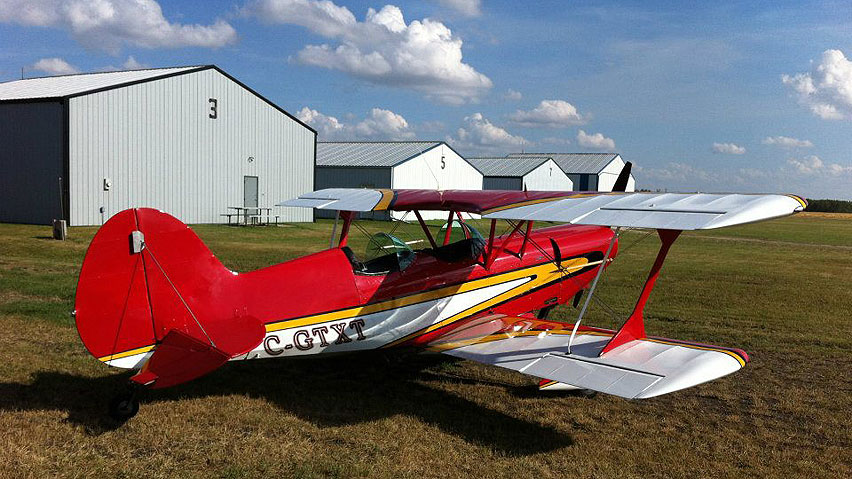 The Acrosport II is described as an aerobatic training aircraft and nimble in the air.


 WAYNE GLOWACKI / WINNIPEG FREE PRESS


